

Out on the HQ balcony this morning, I was leaning against the rail, looking past the palm trees and out toward the hazy Florida horizon. Riplee is working remotely today, likely from a beachfront cafe with a much better view than my stack of monitors. The Intern is around here somewhere, probably trying to figure out why the breakroom microwave only spins counter-clockwise, but for now, it’s just me, a fresh pot of dark roast, and a few quiet minutes above the noise.
I stayed there for a moment, watching the light settle over the property and thinking about the people we protect, when a priority notification chirped.
It wasn't a digital breach. It was a story from a reader named Sarah. She called it "The Friendly Stranger." By the time I finished reading her message, my coffee was cold, and my "stay one step ahead" instinct was screaming.
Sarah’s story didn't start with a hacker in a dark room. It started with a smile in a sunny park. It’s a story about how a single, friendly gesture turned into a million-dollar nightmare.
Sarah and her husband were enjoying a Saturday afternoon at Lake Eola in Orlando. The sun was hitting the swan boats just right, and they wanted a photo to remember the day. Before they could even dig a selfie stick out of their bag, a young, well-dressed man approached them.
"You guys look great," he said with an easy smile. "Want me to take a quick photo of you two with the fountain in the background?"
It felt like a random act of kindness. Sarah handed over her iPhone: unlocked, camera app open: and posed with her husband. The stranger took three photos, complimented their style, handed the phone back, and went on his way.
"He was so nice," Sarah wrote.
He was also a professional.

Most people think the risk of handing your phone to a stranger is that they’ll run away with it. That’s the "snatch and grab." It’s loud, it’s obvious, and it’s what we expect. But the Friendly Faces Photo Scam is far more surgical.
When Sarah handed over her unlocked phone, she gave that stranger total administrative access to her digital life for exactly fifteen seconds. Here is what an expert can do in that window:
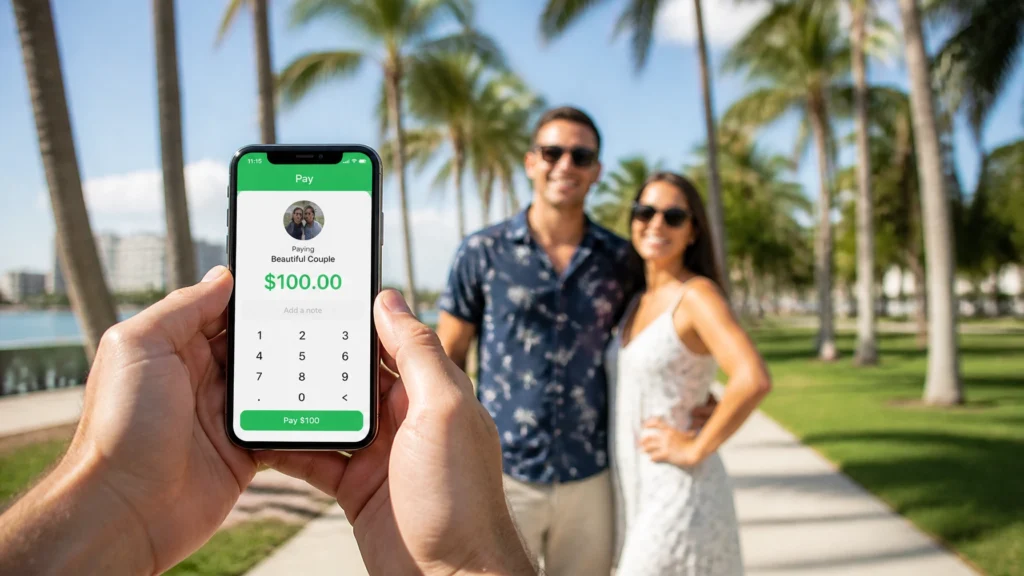
In Sarah’s case, it was a combination of speed and social engineering. While they were posing, he wasn't just clicking the shutter. He was using her phone to target Cash App while pretending to take the photo.

By the following Wednesday, Sarah’s world began to unravel. Her bank called about a $15,000 wire transfer. Then her email password was changed. Then a "forgot password" request hit her crypto exchange. What started with Cash App was only the beginning.
Because the stranger had "trusted" access through her phone's proximity and shared settings, he was able to bypass several layers of Multi-Factor Authentication (MFA). He didn't need to hack her; she had handed him the keys. The "million-dollar" part isn't just the money lost: it's the cost of the legal fees, the identity restoration, and the permanent loss of peace of mind.
Are you being tracked right now? It’s a question that keeps our community vigilant, and for good reason.
We don't tell these stories to make you afraid of the park. We tell them so you can enjoy the park without looking over your shoulder. If you want to stay one step ahead, follow these rules:

At FindASpy.com, we specialize in the "what now?" phase. If you suspect your device has been tampered with: whether by a "friendly" stranger or something more covert: we offer the tools and expertise to find the truth.
The reality of 2026 is that our physical and digital lives are no longer separate. A smile in the real world can be a backdoor in the digital one. But knowledge is our greatest defense.
Before I head back to the monitors (and find out what the Intern did with the thermostat), I want to invite you to look at our Community Finds Museum. It’s where our readers submit the weird, the suspicious, and the outright dangerous things they’ve encountered. It’s a collective effort to keep our neighborhood safe.

Let’s Talk.
If something feels off, don't wait for the bank to call you. Whether you need a vehicle scan, a property sweep, or a deep-clean of your smartphone's permissions, we are here to help. Explore our Article Archives for more guides, or reach out to us directly through our About Us page to learn more about our licensed and insured investigative team.
Every time I share a story like Sarah’s, I’m reminded of how much we rely on the kindness of strangers: and how that kindness is being weaponized.
Which State are you reading this from? (I'm here in the sunshine state of Florida!)
Have you ever felt "off" after handing your phone to someone? Did you check your settings afterward?
Has anyone ever tried a variation of this scam on you?
Share your thoughts below. Your experience might be the exact warning someone else needs to hear today.
We love hearing from you. If your comment is chosen as "Tracer's Pick," you might just receive a free spyware device from our team. I read every single post, so let's talk.
You can also upload your own hidden or suspicious gadgets to share with the community by clicking here.
Stay vigilant, stay safe, and I’ll see you tomorrow morning. The coffee will be hot: I promise.
( Tracer)
Your vote helps determine FindASpy Insider’s Readers’ Top Picks. One rating is allowed per reader for each article.
Today’s Coffee Conversation
Tracer shares cybersecurity stories, scam alerts, privacy tips, and investigative insights. Pull up a chair, share your experience, and help shape tomorrow’s discussion.