

If you are reading this on Tuesday morning, August 11, 2026, welcome back to Morning Coffee with Tracer. You can explore our complete archive anytime over at our Morning Coffee Archive.
Right now, my favorite café has committed a Monday-level offense against civilization: they ran out of to-go cups. So instead of walking out with my usual coffee, I got handed a chipped ceramic mug that leaks just enough to keep me moving it away from my notes every thirty seconds. Small problems, sure. But they still beat the kind of digital mess that landed on my desk before breakfast.
But annoyance with café acoustics takes a back seat when real-world digital threats land on my desk. Late last week, my phone buzzed with an urgent consultation request from a long-time reader: let’s call him Marcus: whose identity had been systematically shredded over a forty-eight-hour window. Scammers had managed to open three separate credit lines and a high-limit retail account in his name.
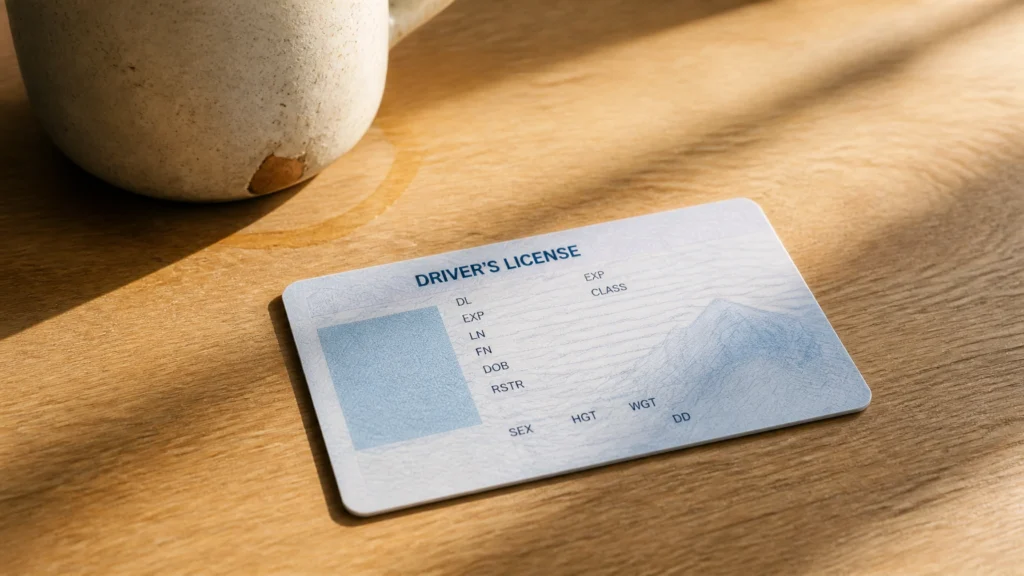
When Marcus pulled his credit reports, he noticed something terrifying: the fraudsters had not just used his Social Security number; they had successfully plugged his exact Driver’s License (DL) number into verification forms to bypass secondary security checks.
Marcus was baffled, and honestly, so was I at first glance. “How did they get my driver’s license number?” he asked me over the phone. “I keep that card locked in my RFID wallet. I haven’t rented a car or been pulled over in two years. Nobody photographed it.”
The answer to Marcus’s question is both simple and deeply unsettling. In many states, your driver’s license number isn’t a random string of numbers assigned by a secure, encrypted government database. It is a formula. And if scammers have your basic personal information, they don’t need to steal your physical card to figure out what is on it.
For years, most citizens operated under a comforting assumption: our official state identification numbers: Social Security numbers, passport numbers, and driver’s license numbers: were generated like cryptographic keys. We assumed they were random, complex, and closely guarded behind state firewalls.

The truth is far more bureaucratic. To manage millions of records efficiently across legacy state computer systems decades ago, many departments of motor vehicles engineered algorithmic formulas to encode a driver’s name, gender, and date of birth directly into the license number itself.
While some states have modernized and transitioned to randomized numbering systems, many states still rely heavily on deterministic formulas. This means that if an attacker knows your full legal name, your date of birth, and your gender, they can reverse-engineer or compute your state driver’s license number using publicly available calculation tools.
This is one rare instance where we are going to pull back the curtain and show you how a vulnerability works so that you can understand the exact danger and protect your personal data.
For educational and security demonstration purposes, researchers and cybersecurity analysts frequently reference specialized utility scripts, such as the ones hosted on Highprogrammer. If you look up tools like the Highprogrammer Unique ID Calculator (which includes formulas for states like Illinois, Florida, and Washington), you can see the math in action.

The process looks something like this:
When a scammer enters your first name, middle initial, last name, gender, and date of birth into one of these calculators, the script instantly spits out a remarkably accurate prediction of your driver’s license number.
You might be thinking: Fine, the algorithm exists, but where do they get my birth date and middle name?
The unfortunate reality is that we hand these ingredients over voluntarily every single day through digital oversharing:
Once a scammer compiles this dossier, calculating your driver’s license number takes seconds. Armed with both your SSN and your calculated DL number, online credit applications sail right through automated identity verification checks.
We cannot rewrite state DMV algorithms overnight, but we can dramatically harden our personal perimeter against this specific vector of attack. Here is how you stay one step ahead:

Before you head out into your busy week, here is your Tuesday morning challenge:
Go into your social media privacy settings right now and restrict your birth date so only you can see it. Next, run a quick vanity search of your own name to see what public records expose your vital information. Awareness is our strongest shield.
If you have stumbled upon a strange gadget, a suspicious tracking device, or want to share your own privacy find with our community, remember to upload it over at our Community Finds Page.
Disclaimer: The stories Tracer shares are based on real scams and security threats actively targeting our community. While the names and specific scenarios are crafted to protect identities, these tactics are a matter of when, not if. Tracer brings these to you fresh — so you see it here before it shows up at your door.
We want to hear from our community!
Drop your thoughts and questions in the comments below. I read every single post right here from the desk at headquarters!
(Need immediate assistance or want to talk to a real investigator? Give our office a call at 321-342-0040 and ask for Patricia: she’s keeping the coffee pot hot and our operations running like clockwork!)
Your vote helps determine FindASpy Insider’s Readers’ Top Picks. One rating is allowed per reader for each article.
Today’s Coffee Conversation
Tracer shares cybersecurity stories, scam alerts, privacy tips, and investigative insights. Pull up a chair, share your experience, and help shape tomorrow’s discussion.