



Are you being Tracked? Does your ex always seems to know exactly what coffee shop you’re sitting in, down to the minute. Well real GPS Trackers update every minute or less. Which also means whoever is tracking you is paying monthly/yearly for it. Because for it to update every minute it has to have a mobile SIM card inside it. We all know Mobile service isn’t free.
You aren’t crazy. You aren’t being paranoid. As a former Private Investigator turned TSCM (Technical Surveillance Countermeasures) Specialist with over 35 years in the game, I’ve seen it all. I’ve crawled under thousands of vehicles, burned my knuckles on hot exhaust pipes, and pulled little black plastic boxes out from places you wouldn’t believe. Catching the bad guy is always refreshing, but giving victims of privacy invasion their peace of mind back? That’s why I do this.
My buddy Trace (a brilliant white hat hacker) and I are currently building a sanctuary for privacy here. Consider this article your first official masterclass. Today, we’re diving deep into GPS tracker detection. We’re going to talk about the gear, the methods, and exactly how to sweep a car for GPS trackers like a seasoned pro.
Let’s get to work.
Before you drop money on a high-end GPS bug sweeper, let’s look at the context. Tracking someone used to require a private investigator sleeping in a Dodge Diplomat across the street. Today? Any stalker, jealous partner, or overzealous parent can buy a magnetic tracker on Amazon for thirty bucks.
Here are the signs your car is being tracked:
The “Coincidences”: Someone consistently shows up where you are.
Hyper-Specific Knowledge: People in your life know about errands or appointments you haven’t discussed.
Weird Battery Drain: If a hardwired tracker is improperly installed, it can siphon your car battery over the weekend.
Unknown Tracker Alerts: You’re getting Bluetooth notifications on your phone (which brings us to detecting AirTags on Android 2026—yes, Google finally baked background scanning into the OS to match Apple, so pay attention to those pop-ups!).
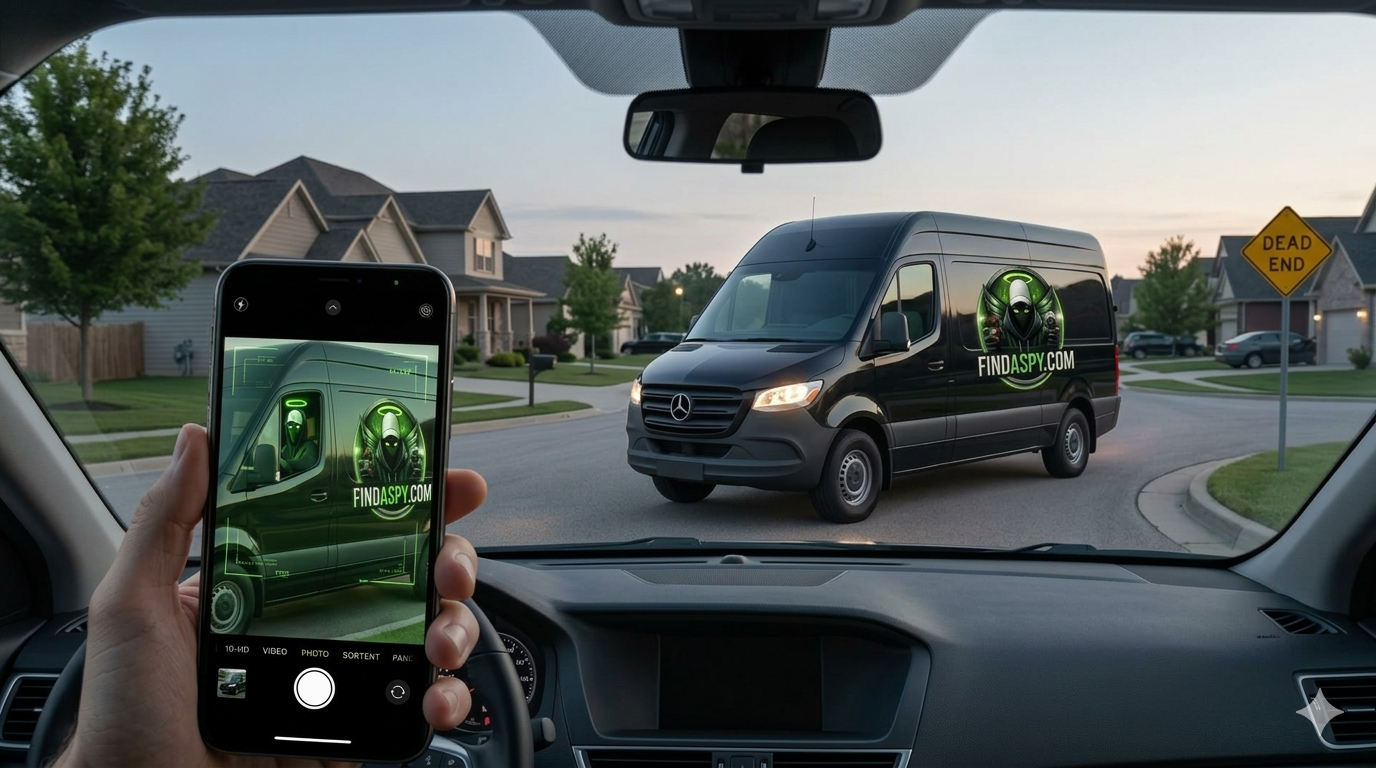
“If you suspect someone is tracking you in real-time—like an obsessed ex or a private investigator—you have a critical edge: their adrenaline usually overrides their logic. They get impatient. A person watching a stationary GPS dot on a screen often assumes you’ve reached a destination or a ‘rendezvous,’ and that makes them reckless. Use this psychology to flip the script. Start by looking on Google Maps and picking out a quiet dead-end street near your home. Go there, turn your car around so you are facing the only exit, and immediately be ready with your smartphone camera.
In most cases, whoever is following you will turn down that street thinking they’re about to catch you, only to find themselves driving directly into your camera’s lens. They never expect you to be waiting for them head-on, because they think they’re the ones in control. You will have a perfect, head-on recording of their face, their license plate, and the undeniable proof you need. You’re not looking in your rearview mirror; you’re ready to capture their surprise.”
⚠️ Safety First Disclaimer: Important Safety Note: This tactic should be used with extreme caution. Prioritize your physical safety above all else. Do not confront a suspected tracker. We strongly recommend executing this maneuver from within your locked vehicle and only when other people are not in the car with you. Do not exit your vehicle under any circumstances. If the individual exits their vehicle or behaves in a threatening manner, do not record; call 911 immediately. The goal is to safely gather information, not to put yourself in danger. Use this trick responsibly
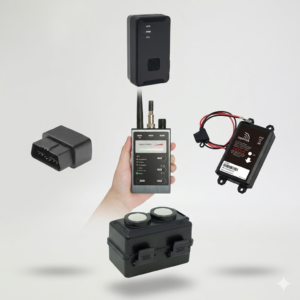
When I perform a physical security audit, the first thing I do is step into the shoes of the person who planted the device. To find a bug, you have to think like the one hiding it. But before you start tearing apart your upholstery, you need to know exactly what you’re hunting for. 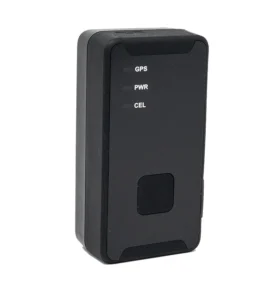
Start with a deep dive into Google Images. Search for “GPS Trackers” and don’t just look at the first few hits. Scan four or five pages deep until you have a solid “mental catalog” of the hardware. You’ll notice a common theme like in the photo above: small, black, weatherproof boxes with heavy-duty magnets. This is the #1 style for trackers used by those who don’t have access to the interior of your vehicle. If it’s stuck to the frame or a wheel well, that’s likely what you’re looking for. 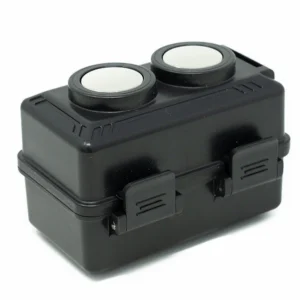
The second most popular hiding spot is the OBD (On-Board Diagnostics) port. This is the easiest “plug-and-play” option for a tracker. To find yours, search Google for your vehicle’s [Make/Model] + “OBD port location.” Usually, it’s tucked under the left side of the dashboard and looks like a wide, rectangular plug with multiple pin holes (similar to an old-school VGA cable). If there is anything plugged into that port that didn’t come with the car, pull it. 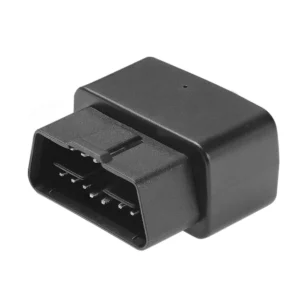
The third most common variety is often used by rental agencies or “buy-here-pay-here” lots to act as a remote kill switch. These aren’t just stuck on with magnets; they are hardwired directly into the vehicle’s power supply. When you pop the hood, inspect the battery terminals. If you see unauthorized wires—especially ones leading to a small plastic module tucked near the firewall—you’ve likely found a permanent tracking installation.
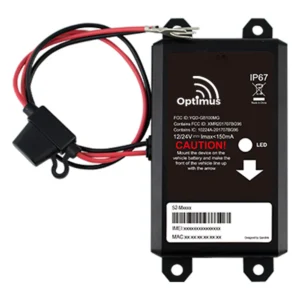
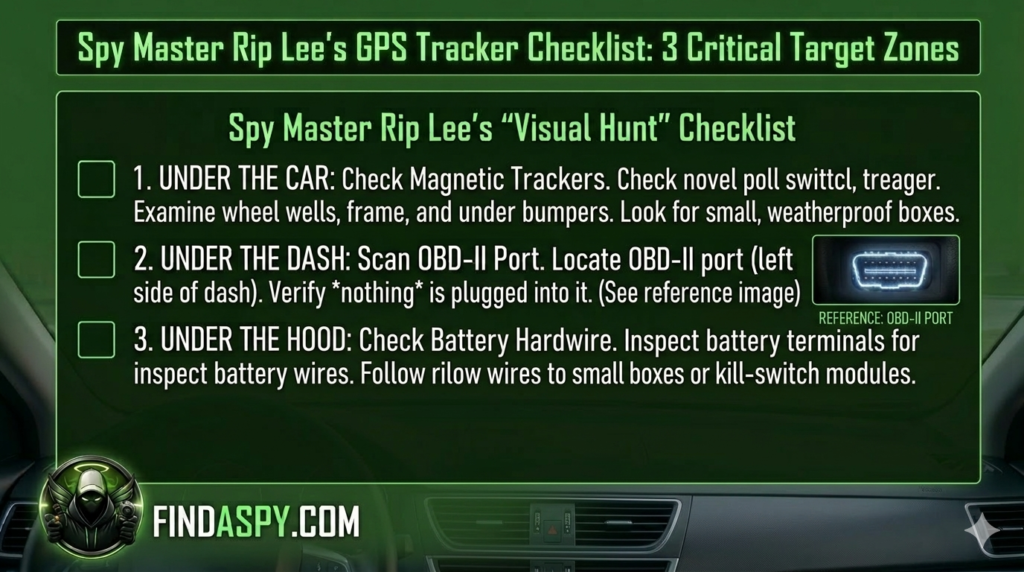
The Undercarriage (The Quick Slap): Using a magnetic probe on a hidden tracker finder, if you have one, wave it everywhere underneath the vehicle; as far as an arm could reach. It will alert you to any heavy duty earth magnets. The ones that house the GPS tracker underneath your car. I always check the wheel wells, the metal frame directly behind the bumpers, and right above the splash guards.
The OBD-II Port (The Plug-and-Play): If someone has access to the inside of your car, an OBD-II port security check is mandatory. The OBD-II port is under your steering wheel. Trackers plugged in here look like little diagnostic modules and pull infinite power straight from your car.
Under the Hood (The Pro Job): If a tracker is wired directly to the battery or fuse box, it’s there to stay. Look for alien wires spliced clumsily into the factory wire harness.
You can only get so far with a flashlight. To truly verify a vehicle is clean, you need to conduct an electronic sweep for trackers. The market is flooded with cheap junk that beeps at your own smartwatch. You need a dedicated GPS signal detector. Here is our best Findaspy tools for detecting GPS tracking devices, ranging from elite professional gear to consumer-friendly sweepers.
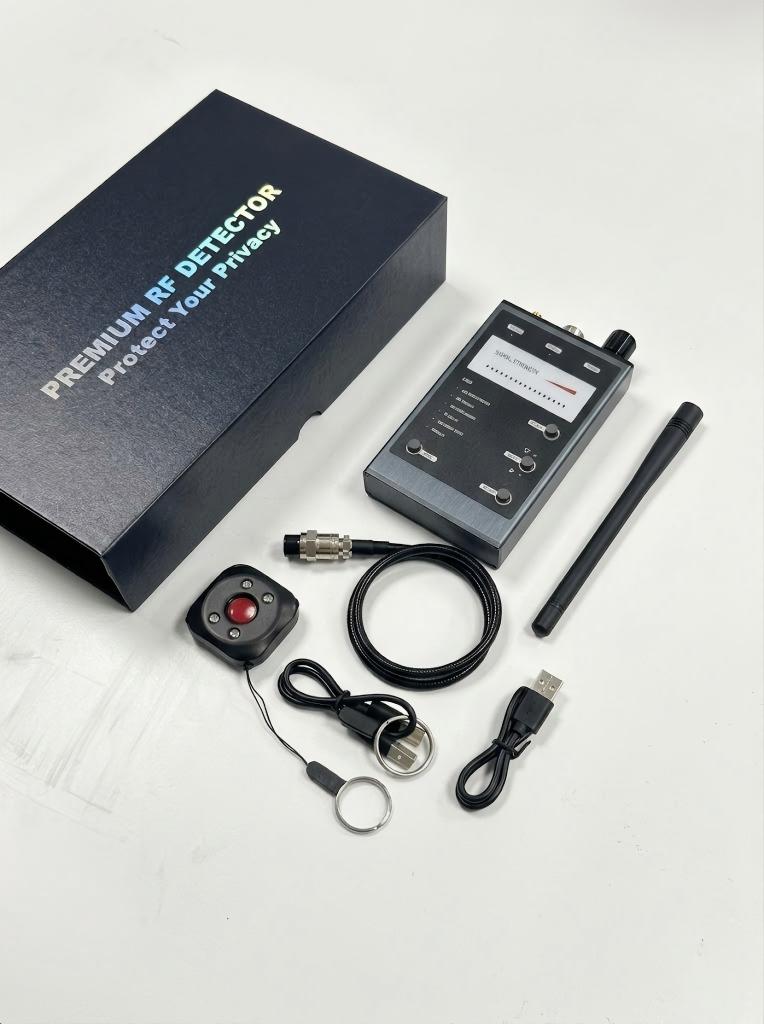
“When using an RF Detector to detect GPS Trackers there are some very important factors to your success. I should be charging for this information because this is how I find Trackers that no one else was able to. and that is…..Call Me because I can’t put all my tricks on the internet. I’ll still tell you for a 5-Star Review. When you call me! Spy Master Rip Lee”
You’ve got questions; I’ve got three decades of answers. Let’s clear up the confusion.
1. Can my phone detect a GPS tracker on my car? Yes, but with huge limitations. Via “Unknown Tracker Alerts” (on both iOS and Android), your phone can spot Bluetooth tags like AirTags or Tiles. But a phone cannot detect a professional cellular GPS tracker.
2. How do I find a tracker if it is “dormant” or turned off? You need a Non-Linear Junction Detector (NLJD), like the REI Orion. It shoots a microwave signal that bounces off the silicon inside electronics, letting you find trackers even if their batteries are dead.
3. What is the most common place to hide a tracker? For amateurs: The OBD-II port. For PIs and stalkers: Inside the plastic bumper covers or tucked high up inside the rear wheel wells.
4. Do I need an internet connection to use a bug sweeper? No. RF detectors and bug sweepers pick up raw radio frequencies emitted by the tracker itself. They are completely independent of the internet.
5. Will a cheap GPS detector find a 5G tracker? Usually, no. If you’re looking for the best 5G GPS tracker detector, you have to spend a little money. Cheap Amazon detectors often max out at low frequencies, completely missing modern high-band 5G/LTE-M signals.
6. Can a “passive” tracker be detected electronically? Passive trackers (which log data to an SD card but don’t transmit over cellular networks) emit almost zero RF. They must be found via a rigorous physical inspection or by using an NLJD.
7. Is it legal to remove a tracker I find on my car? If you own the vehicle outright, generally yes. However, do not throw it away immediately. Document it, take photos of where it was placed, and contact law enforcement or a lawyer. It is evidence.
8. How long do GPS tracker batteries last? Magnetic battery-powered units usually last 1 to 4 weeks, depending on how often they ping. Hardwired units (connected to the car battery or OBD port) last forever.
9. Can a mechanic find a hidden GPS tracker? Absolutely. A good mechanic putting the car on a lift for an oil change has the perfect vantage point to spot magnetic trackers on the frame or alien wiring under the hood.
10. Do bug sweepers give false positives? Yes, constantly! Wi-Fi routers, passing cell towers, and even your own key fob can trigger an RF detector. That’s why you must isolate the car in a quiet environment before sweeping.
Listen to me: your privacy is a fundamental right, not a luxury. Whether you are dealing with a bitter divorce, an obsessive ex, or corporate espionage, taking control of your physical security is the first step toward breathing easy again.
Don’t let the technology intimidate you. Whether you decide to grab a flashlight and crawl under the chassis today, or you decide to search for “GPS tracker detection near me” to hire a pro, you are taking back your power.
Are you dealing with a suspicious device on your vehicle right now, or just preparing for the future? Reach out to us directly to get a Vehicle Sweep from a Licensed Private Investigator near you. If you’re in Clermont, Florida call
Author: Rip Lee, TSCM Specialist and Co-Founder of Findaspy.com
Your vote helps determine FindASpy Insider’s Readers’ Top Picks. One rating is allowed per reader for each article.