


$1,500.00 Original price was: $1,500.00.$1,369.99Current price is: $1,369.99.
Stop eavesdropping that never puts a device inside your room. The DNG2300-4 injects vibrational white noise into walls and windows, defeating laser mics and contact microphones
iProtect 3-Channel White Noise Generator Kit | Defeats Laser Mics & Contact Mic Eavesdropping, Small Rooms
Every detector and anti-recorder solves a version of the same problem: something is inside the room, and you either need to find it or drown it out. But the most sophisticated eavesdropping methods don’t put anything inside the room at all. A laser microphone can read the vibrations off your office window from across the street. A contact microphone, an electronic stethoscope, can be pressed against a shared wall, a pipe, or a ceiling from the next room or the floor above and pick up your conversation through the structure itself. No RF detector will ever find these, because nothing is transmitting. No anti-recorder will ever block them, because there’s no microphone anywhere near you to interfere with.
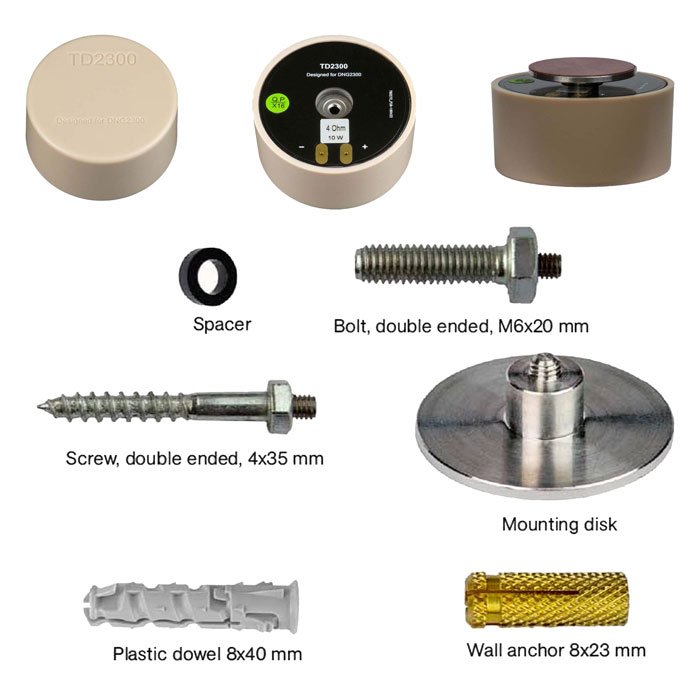
The DNG2300-4 is built specifically to close that gap. Instead of jamming a signal or a nearby microphone, it injects a controlled vibrational white noise directly into the surfaces most likely to leak sound, your walls, windows, and other structural elements, using included transducers and an acoustic speaker. Any device trying to listen through those surfaces, whether it’s a laser reading window vibrations or a contact mic pressed against drywall from the next room, picks up the injected noise along with your conversation, and that noise can’t be filtered out after the fact. Your words get buried in vibration the eavesdropping device itself is capturing.
Kit 4 is sized for small areas, offices, private conference rooms, and labs, where a compact, well-placed set of transducers and a speaker is enough to cover the room’s vulnerable surfaces. It’s a permanent, installed layer of protection rather than something you carry room to room, which makes it the right fit for a specific space you need protected every single day, not just for the length of one meeting. For anyone who’s already covered the airwaves and the microphones on the table but knows a determined adversary doesn’t need to be in the room to listen, this closes the last structural gap.
Don’t leave your walls and windows as the one thing you never protected. Order the iProtect 3-Channel White Noise Generator Kit 4 today and secure your space against eavesdropping that never sets foot inside it.
1. What kind of eavesdropping does this actually stop? It’s designed to defeat vibro-acoustic eavesdropping methods that read sound through vibration rather than picking up an RF signal, including laser microphones aimed at windows, contact microphones (electronic stethoscopes) pressed against walls or pipes, and other structure-borne listening methods.
2. Why wouldn’t an RF detector or anti-recorder catch this instead? RF detectors look for transmitting devices, and anti-recorders interfere with nearby microphones, but laser and contact-microphone eavesdropping doesn’t involve a device inside the room or an RF transmission at all, so neither approach can detect or block it. The DNG2300-4 works at the structural level instead.
3. What’s included in Kit 4? Kit 4 includes the 3-channel white noise generator, 3 transducers (TD-2300), and 1 acoustic speaker (SP-2300), sized for small rooms.
4. How does it actually work? The generator drives the transducers and speaker to create controlled vibrations on the surface of walls, windows, and other structures in the room. Any listening device reading vibration from those surfaces picks up the injected noise along with your conversation, and that noise can’t be filtered out afterward.
5. Is installation required? Yes. This is a permanently mounted system rather than a portable, plug-and-play device, and proper placement of transducers and speakers across the room’s vulnerable surfaces is required for effective coverage.
6. How many transducers do I actually need for my room? It depends on the size and construction of the room; larger or more complex spaces need a wider spread of transducers and speakers across the walls, windows, and other surfaces to ensure full coverage, which is why larger kits (Kit 8, Kit 12) are available for bigger areas.
7. Will people in the room hear the noise? The system produces a low-level audible interference at the wall and window surfaces themselves rather than in the open air of the room, so it’s designed to protect the room without disrupting normal conversation for the people inside it.
8. What’s the difference between Kit 4, Kit 8, and Kit 12? They scale with room size. Kit 4 is built for small areas like a single office or small conference room, Kit 8 covers larger rooms, and Kit 12 (the DNG KIT1) is a portable, larger-capacity kit housed in an aluminum case for bigger spaces or multi-room deployment.
9. Is this a substitute for RF bug detection or room-wide anti-recorders? No, it’s a complementary layer. RF detectors and anti-recorders address devices and phones inside or near the room; this system addresses eavesdropping methods that never put a device in the room at all. Using them together covers a significantly wider range of threats than any one product alone.
10. Who typically installs a system like this? It’s most commonly used by businesses, law firms, R&D labs, and executive offices securing a specific room they use for sensitive conversations on an ongoing basis, and is often installed as part of a broader TSCM security plan.

Complete the form below and a member of our team will contact you to discuss your video security needs.
Reviews
There are no reviews yet.