

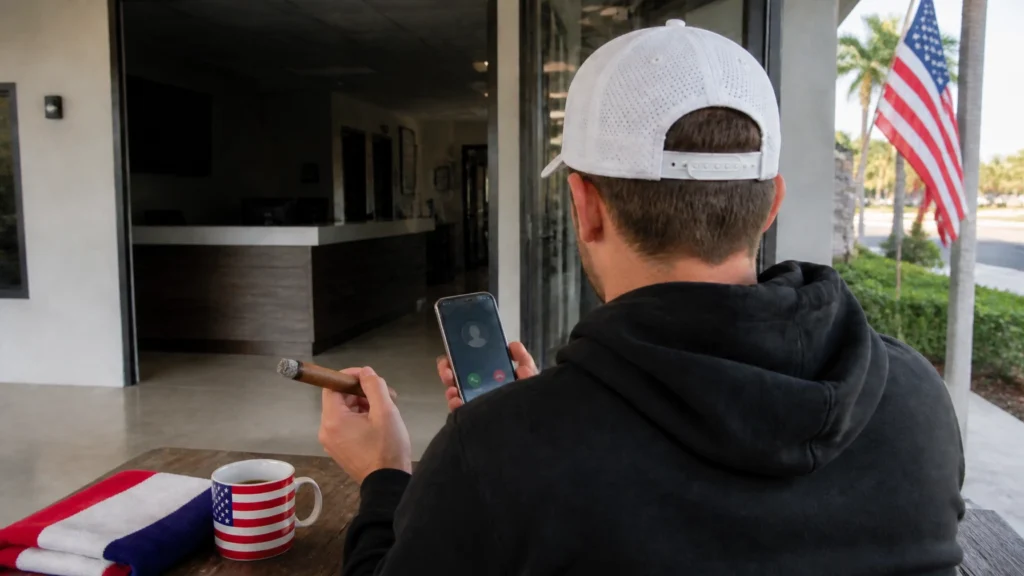
FindASpy headquarters was officially off the clock for Labor Day.
The lights were off. The front desk was quiet. The team was enjoying the holiday like sensible people who know a closed office is a beautiful thing.
I was away from the usual routine, nowhere near the whiteboards, the cables, or Fernando the fern and his increasingly judgmental leaf placement strategy.
I had a holiday coffee in one hand and a Kuba Kuba cigar resting nearby when my phone rang.
Holiday timing has a strange sense of humor.
The call led into an already researched, authorized assessment involving an old phone number and a very modern account problem. Even on a holiday, an old phone number can keep working for someone else. Accounts do not take the day off when their recovery settings are outdated.
An SMS verification code appeared on the screen.
The code was legitimate. The platform was legitimate. The login attempt was not.
I was working as a cybersecurity engineer on an authorized security assessment. Our team needed access to a platform connected to an old phone number. The account required an SMS authentication code, but the number on file had been disconnected and was no longer controlled by its original user.
We looked for the simplest authorized path to demonstrate the weakness.
The number had returned to the carrier’s available inventory. I contacted AT&T and used a social-engineering pretext to request that specific number, explaining that it held personal significance. The request succeeded. The number was reassigned to me.
When the platform sent its SMS code, the message came to my phone instead of the former account holder’s phone. I completed the password reset and entered the account.
That was the entire lesson.
No sophisticated malware. No dramatic movie-style hacking. No locked server room.
The phone number changed hands, and the account still trusted it.
If a cybersecurity engineer can demonstrate that weakness during an authorized assessment, criminals can exploit the same underlying condition for financial theft, identity fraud, stalking, and account takeover.
Many people think of a phone number as a permanent identity. It is not.
A phone number is a leased telecommunications identifier. When a subscriber cancels service, changes carriers, or gives up a line, the number eventually leaves that person’s control. The carrier places it into an aging period and later returns it to the available pool.
Under the Federal Communications Commission’s reassigned-number rules, permanently disconnected numbers receive a minimum aging period of 45 days before reassignment. Residential numbers generally follow an aging window of at least 45 days and no more than 90 days. Business numbers follow a longer maximum window.
After that period, the number is not permanently retired. It is reassigned to another customer.
That new customer receives calls and text messages sent to the number. Those messages include account alerts, password-reset links, appointment reminders, and SMS authentication codes when an old account still lists the number.
The FCC’s Reassigned Numbers Database supports caller compliance and helps identify numbers that were disconnected. It does not automatically remove an old phone number from your bank, email, cloud, social media, or financial accounts.
Princeton’s Center for Information Technology Policy documented this risk in its research on phone-number recycling. Researchers found recycled numbers still connected to prior owners’ accounts and sensitive communications.
The practical sequence is simple:
That is why SMS authentication is a weak link. A one-time code sent by text is a standard, legitimate tool used by banks to prove identity. It is useful, but the code is only as secure as whoever controls the phone number at that moment.

The number itself is only one part of the risk.
A criminal starts with information about the former holder. Public profiles, data-broker listings, breached databases, old business pages, online directories, and social media posts all create clues. The phone number becomes a search key that connects those clues.
The criminal then looks for accounts associated with the old number. Email accounts are especially valuable because they often control password resets for other services. Banking, investment, cryptocurrency, cloud storage, shopping, health, and social media accounts also attract attention.
The next step involves obtaining control of the number. That route is not always a recycled-number reassignment. It also includes carrier social engineering, SIM takeover, or port-out fraud.
Once the criminal controls the number, the attack becomes a post-authentication problem. A criminal who controls a recycled number can request password resets, receive SMS challenges, impersonate the account owner, and move deeper into connected accounts.
The important point is this: the criminal does not need to break the platform’s encryption. The platform is doing exactly what it was designed to do. It sends the code to the phone number stored in the account.
Changing a phone number is an ordinary life event.
A person retires and leaves an employer-sponsored phone plan. A family changes carriers to reduce its monthly bill. A parent gives up a landline. A small business closes an old office line. Someone escapes harassment and replaces a number for personal safety.
The account updates are less ordinary.
People remember the bank, email, and primary social media account. They forget the old airline profile, tax software account, medical portal, online marketplace, cloud backup, password manager, or device account created years earlier.
Working families face the same pressure. A parent changes numbers during a move, a divorce, a job change, or a carrier switch. Then the family rushes to restore access to everyday services. The old number remains attached to accounts in the background.
Seniors and retirees are also frequent targets because SMS codes feel familiar and reassuring. A caller says, “Read me the code so I can secure your account.” The victim sees a real bank message and assumes the caller is legitimate.
The code is real. The caller is not.
Pay attention when any of these events occur:
Do not forward the code. Do not read it to the caller. Do not click a link in the message.
Open the company’s official app or type its known website address manually. Contact the institution through the number printed on your statement or the back of your card.

Write down every service tied to the number. Start with email, banking, credit cards, investment accounts, cryptocurrency platforms, cloud storage, social media, shopping, medical portals, tax services, password managers, and smart-home systems.
Search your email for terms such as “verification,” “security alert,” “two-factor,” “password reset,” and “phone number.” Those messages reveal accounts that require attention.
Update the recovery number before the old line stops working.
Move sensitive accounts to a time-based authenticator app, known as TOTP, or to a hardware security key. These methods do not depend on a recycled phone number.
SMS remains better than no second factor, but it does not provide durable control of an identity. Treat it as a backup channel rather than the strongest available protection.
Download or print each service’s backup codes. Store them in a protected password manager or a secure physical location.
Do not save the codes in an unprotected note labeled “bank backup codes.” That turns one security measure into a convenient invitation.
If a number is connected to important accounts, consider keeping control through a reputable number-parking service or a service such as Google Voice, after reviewing the provider’s security and recovery policies.
The objective is simple: do not abandon a number while accounts still trust it.
Set a unique carrier account PIN and enable every available port-out, SIM-change, and number-lock feature. Verizon, for example, provides Number Lock for eligible accounts. Other carriers use different names and settings.
Ask the carrier which protections apply to your line. Place account changes behind identity verification that does not rely solely on the phone number being protected.

Act quickly.
Change the recovery number on your email and financial accounts first. Replace SMS authentication with an authenticator app or security key. Review recent login sessions, trusted devices, forwarding rules, recovery emails, and account-change alerts.
Contact your bank or financial institution through an official channel and explain that the old phone number is no longer under your control. Ask for a fraud review if any account changes are unfamiliar.
If you suspect unauthorized access, preserve the alerts and messages. Do not delete evidence. A professional cyber consultation can help organize the issue, while FindASpy’s secure phone resources and spyware and breach-removal services provide additional privacy support.
FindASpy is built around awareness, knowledge, and protection. Learn more about the team through About Us, or review available privacy and security equipment in the All Products catalog.
Before sending money, installing software, changing account settings, or sharing information, stop. Independently verify the request using a trusted phone number or official app. Contact someone you trust before acting under pressure.
The number you gave up is no longer yours. Your accounts must stop treating it as if it is.
This article is provided for general educational and cybersecurity-awareness purposes. The authorized assessment described above was conducted in a controlled professional context. Do not impersonate customers, manipulate carrier representatives, access another person’s accounts, intercept messages, or test systems without written authorization. Laws and carrier policies differ by situation. If you suspect account takeover, contact your carrier, financial institution, relevant platform, and appropriate authorities through official channels.
Have you ever changed phone numbers and later discovered an old account still had the previous number attached? Which State are you reading from?
What is the oldest online account you still use? Have you checked its recovery settings recently? Do you prefer an authenticator app, a hardware security key, or SMS verification?
Tracer reads all posts, and your experience could help another family protect a trusted space.
If you have discovered a hidden gadget, suspicious device, or unusual privacy concern, upload it for the community by clicking here.
Tracer’s Pick is our occasional way of highlighting a practical privacy or security item from the FindASpy catalog. A selected reader may receive the featured item, subject to availability and the applicable giveaway terms. Keep an eye on future Coffee Time posts for details.
A phone number is not a permanent identity. When control ends, account recovery must change with it.
Before your next cup of coffee, search your email for “verification” and “password reset.” Make a list of every account connected to your current or former phone numbers. Remove old numbers, save backup codes, and strengthen your most important accounts.
Sterling Reed, known to FindASpy readers as “Tracer,” is a cybersecurity engineer, digital investigator, consumer cybersecurity contributor, and founder of FindASpy.com in Clermont, Florida.
Learn more about Sterling Reed, his professional background, credentials, and published cybersecurity work →
Your vote helps determine FindASpy Insider’s Readers’ Top Picks. One rating is allowed per reader for each article.
Today’s Coffee Conversation
Tracer shares cybersecurity stories, scam alerts, privacy tips, and investigative insights. Pull up a chair, share your experience, and help shape tomorrow’s discussion.