

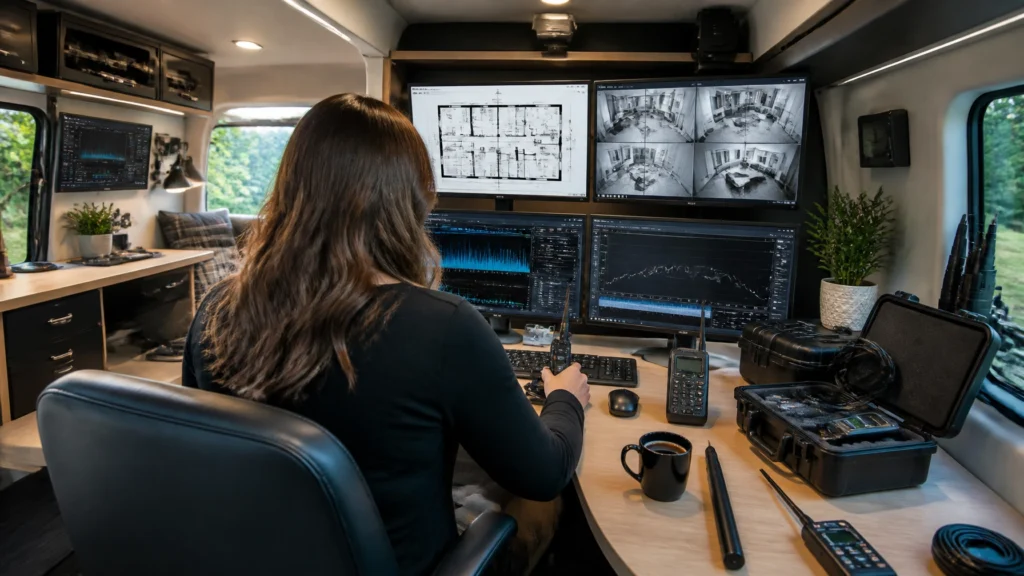
The humidity in Florida is thick today, the kind that makes you feel like you’re breathing through a warm, wet towel. I’m in the back of the FindASpy Van, checking monitors and testing equipment before heading into a sweep. Every case starts this way for me: coffee close by, gear lined up, and one last quiet pass to make sure everything is reading clean before I roll out.
I’m on my second cup of coffee, dark roast, no cream, because some things in life should remain uncomplicated. In the mobile lab, every screen, cable, and detector has a purpose. Privacy isn’t just a legal term; it’s about protecting the spaces where people are supposed to be able to breathe, sleep, think, and live without someone watching from the shadows.
The peace was broken about twenty minutes ago by a call from Leo, an old friend who runs a small architecture firm. He didn’t waste time with small talk. He told me he’d just come back from an Airbnb in Orlando for a conference, and that he had found a digital alarm clock on the nightstand next to the bed that didn’t feel right.
“Tracer,” he said, his voice tight. “I was at an Airbnb in Orlando for a conference. I felt… watched. I found this on the nightstand, right next to the bed.”
I leaned in. At first glance, it was a standard, cheap LED clock. But something about the plastic face didn’t sit right. It was just a little too glossy, a little too dark.
“Let’s have a look,” I told him.
Are you being tracked? Are you being watched? These aren’t just paranoid questions anymore. They are the realities of a connected world. Today, we’re going into the master’s guide on finding hidden cameras in your rentals.
When you book a hotel or an Airbnb, you’re paying for more than a bed. You’re paying for a private sanctuary. But the headlines don’t lie: hidden cameras in bedrooms and bathrooms are becoming a common nightmare. Whether it’s a voyeuristic host or a previous guest who left a “gift,” the threat is real.
In Leo’s case, the clock was aimed directly at the pillows. Most people wouldn’t blink twice. They’d plug in their phone and go to sleep. But Leo had been reading my investigation logs, and his gut told him to pull the plug.
Before you pull out any high-tech gear, use the best tool you have: your brain. A hidden camera needs two things to be effective: Power and Perspective.
The Perspective: Think like a voyeur. If you wanted to see the room, where would you look? Check the smoke detectors, the vents, the picture frames, and anything directly facing the bed or the shower.
The Power: Most hidden cameras are “parasitic.” They need to be plugged into an outlet to run 24/7. Follow the cords. If a lamp has an extra wire coming out of the base, or if a USB wall charger is plugged into an outlet but nothing is connected to it, you’ve found a primary suspect.

Security experts agree that a simple flashlight can detect about 90% of hidden cameras. Why? Because every camera has a lens, and every lens is made of glass. Glass reflects light differently than plastic.
How to do it:
In Leo’s clock, the lens was tucked behind the tinted plastic of the clock face. To the naked eye, it was invisible. Under a focused beam of light? It shone like a diamond.
Many modern hidden cameras use infrared LEDs to “see” in the dark. While your eyes can’t see this light, your smartphone often can.
The Test: Take a TV remote, point it at your phone’s front-facing camera, and press a button. If you see a flickering purple or white light on your screen, your phone can detect IR.
The Scan: With the lights off, pan your phone slowly around the room. Look for glowing dots that aren’t visible to your naked eye. This is a dead giveaway for a camera equipped with night vision.

If a camera is streaming live to a host’s phone, it’s likely on the local Wi-Fi. You can use apps like Fing to see every device connected to the network.
Look for names like “IPCAM,” “NVR,” or manufacturer names like “Hikvision” or “Dahua.” However, be warned: sophisticated “spies” will rename their devices to something boring, like “HP-Printer-02” or “Smart-Fridge.” If you see a device you can’t account for, it warrants a closer look.
Sometimes, a visual check isn’t enough. Professional-grade counter-surveillance tools can detect the Radio Frequency (RF) signals that cameras emit or use laser-lens detection to find even the smallest pinhole lenses.
Leo didn’t have one of these, but I do. I pulled my RF detector from my desk drawer: past a stack of nonsensical sticky notes the intern left me (one just says “Bread?”): and ran it over the clock. The device chirped immediately. It wasn’t just recording; it was transmitting.

If you find a camera in a private space, do not destroy it. You need it for evidence.
Leo ended up calling the Orlando PD. It turned out the host had “eyes” in three different properties. Because Leo was vigilant, he stopped a predator.
Staying one step ahead isn’t about being paranoid; it’s about being prepared. Knowledge is your best defense.
Let’s talk:
We love hearing from you. If your comment is chosen as “Tracer’s Pick,” you might just receive a free spyware device from our team. I read every single post, so let’s talk. You can also upload your own hidden or suspicious gadgets to share with the community by clicking here. Stay vigilant, stay safe.
( Tracer)
Your vote helps determine FindASpy Insider’s Readers’ Top Picks. One rating is allowed per reader for each article.
Today’s Coffee Conversation
Tracer shares cybersecurity stories, scam alerts, privacy tips, and investigative insights. Pull up a chair, share your experience, and help shape tomorrow’s discussion.