

Morning Coffee with Tracer
Awareness and scam disclaimer: Counterfeit money orders and cashier’s checks are used in real fraud schemes. Never release property, return money, or send funds because a deposit appears in your account. Verify the payment independently with your bank and the issuing institution. This article explains common scam patterns for education and prevention. It does not accuse any particular buyer, bank, or institution.
At FindASpy headquarters, the break-room coffee machine displays PAYMENT ACCEPTED in a very confident green font.
Tracer has learned that this message means almost nothing.
The machine prints those words the instant a card is tapped, before anyone knows whether the payment will actually go through. Last week, a colleague’s card was declined three days after the machine had already congratulated him. The machine has apparently been keeping a list.
Tracer now calls the green message “an opinion.”
He stands beside it with a mug of black coffee containing one ice cube, a habit he picked up somewhere and cannot explain. Before he can ask the coffee machine whether the ice cube has been accepted, a client arrives with a problem that sounds impossible.
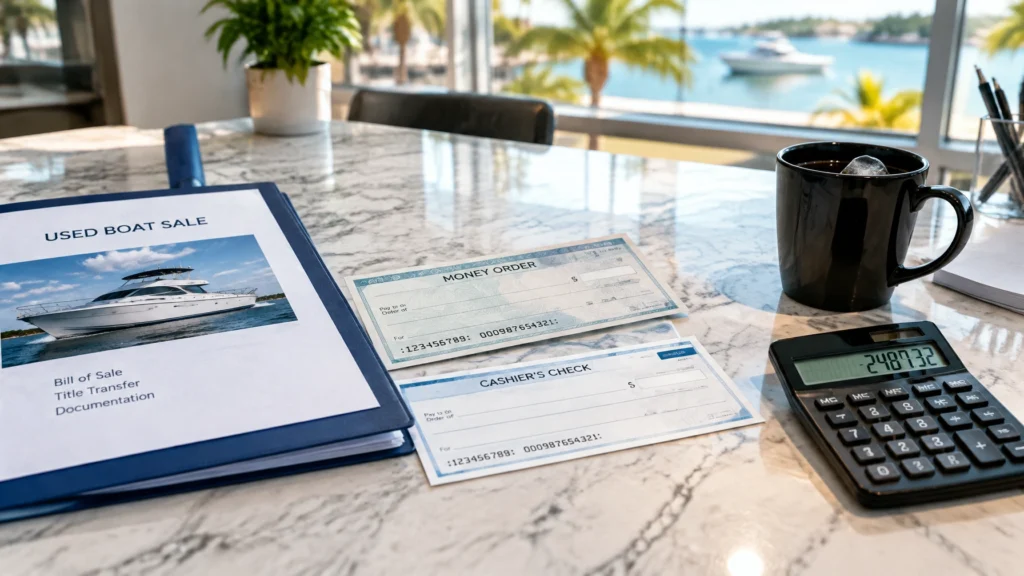
He sold a used boat to a buyer who paid with a money order. The client watched the funds appear in his bank account. The bank showed the money as available. He released the boat.
Three weeks later, the money order came back counterfeit.
The bank reversed the deposit. The client’s account went negative. The buyer had the boat, and the seller had a growing list of fees.
“How could the money order betray me?” the client asks.
Tracer looks toward the coffee machine.
“Payment accepted,” he says, “is not the same as payment settled.”
That distinction is the heart of this scam.
A money order is a prepaid payment instrument. The buyer pays the full amount when purchasing it from a bank, credit union, post office, retailer, or other authorized provider. The document is then given to the recipient as payment.
A cashier’s check is a check drawn on the bank’s own funds rather than directly on an individual customer’s checking account. That is why people often call it “certified funds.”
The appeal is obvious:
That last belief is the dangerous one.
A counterfeit money order or cashier’s check can be returned unpaid just like a bad personal check. It may look completely real because criminals use high-quality printing, convincing bank names, copied security designs, and realistic account information.
The core misconception is simple:
A money order is not a promise from a bank to you. It is a piece of paper that a bank will honor only if it is genuine.
Scammers use several methods, but two appear frequently.
A criminal copies the appearance of a money order or cashier’s check using modern printers and design software. The copy may fool a person at a glance. It may even pass a quick visual check by a busy clerk.
The document can contain:
That phone number is part of the costume. If you call it, someone pretending to work for the institution may confirm the fake payment.
This version is more difficult to spot.
The scammer starts with a legitimate low-value money order, perhaps one for $20. The printed amount, payee, or date is altered so the instrument appears to be worth hundreds or thousands of dollars.
The paper may be genuine. The serial number may be genuine. The security thread may be genuine. A basic serial-number check may even find a real record.
But the amount shown on the paper may no longer match the amount originally issued.
A criminal may also use stolen blank stock, stolen account information, or a mobile-deposit image of an instrument that never physically existed.
The lesson is important: a real-looking serial number does not automatically prove that the amount and payee are authentic.
The client believed the money was his because it appeared in his account. Here is what actually happened.
Your bank accepts the money order or cashier’s check and gives you a receipt.
That receipt proves the bank took the document. It does not prove the document is genuine.
Provisional credit means money the bank makes available while it is still collecting the actual payment. The bank is temporarily showing the amount in your account with the understanding that the credit can be removed.
Federal law, including the Expedited Funds Availability Act and its implementing rule, Regulation CC, requires banks to make certain deposited funds available quickly. Qualifying cashier’s checks and U.S. Postal Service money orders may receive next-business-day availability when deposited under the proper conditions.
This law exists so a bank cannot hold legitimate funds for weeks without reason.
It does not certify that the instrument is genuine.
Fast availability is a customer-service rule, not a guarantee of authenticity.
Your bank sends the instrument through the banking system to the institution that supposedly issued it.
That process may take days. Complicated transactions, unusual institutions, or foreign instruments may take longer.
During that period, your online balance may show the money. That balance can create a false sense of security.
The paying bank examines the instrument and refuses to pay if it is counterfeit, altered, drawn on a nonexistent account, or connected to a closed account.
The return reason may say:
Your bank removes the provisional credit and deducts the amount from your account.
This does not necessarily mean your bank is accusing you. The bank was not paid by the issuing institution, so it removes the money it had temporarily advanced.
This reversal is sometimes called a chargeback or return.
It may happen days or weeks after the deposit.
If you already spent, wired, refunded, or transferred the money, your account is now short.
In banking language, the depositor often bears the loss because the depositor accepted and presented the instrument. Exact responsibility depends on the facts, account agreement, and applicable law, but the practical result can be severe.
The scammer received the product or service during the delay. You receive the reversal.
A counterfeit instrument can cost more than its face value. Possible consequences include:
A fraud victim may even feel treated like a suspect by the bank. The bank sees a bad instrument, a negative balance, and a transaction pattern. It may not immediately see the human story behind it.
That is painful, but ignoring the problem makes it worse. Notify the bank, document the fraud, and ask about a payment arrangement and possible fee review.
The scammer planned the timing.
The boat, vehicle, furniture, equipment, livestock, or completed service is already in the scammer’s hands. It may be moved, resold, or shipped before the payment is rejected.
The phone number, email address, shipping address, and online account may all be disposable.
The buyer sends more than the asking price and asks you to return the difference by wire transfer, payment app, gift card, or money order.
The excuse may involve an accountant, employer, secretary, shipping agent, or mover.
The extra money never existed. Your money is the part that disappears.
A buyer pays for a boat, vehicle, trailer, equipment, or livestock with a money order or cashier’s check. The buyer arranges a shipper and pressures you to release the item.
The shipper may be part of the criminal operation.
A fake landlord accepts a money order deposit from a tenant. Or a homeowner pays a contractor with a cashier’s check that later bounces after the crew has been paid and materials have been delivered.
The scam can move in either direction. Sellers are targeted, but service providers and landlords are targeted too.
A fake employer sends a new worker a check or money order for equipment or software. The worker is told to deposit it, keep a portion, and send the rest for supplies.
The worker becomes responsible when the instrument is returned unpaid.
Someone met online sends an instrument and then claims an emergency requires help. Another version involves a fake refund that must be returned quickly.
The relationship is used to replace verification.
A small business receives payment for stock, ships the order, and later discovers the instrument is counterfeit.
Small businesses are attractive targets because one large loss can affect payroll, inventory, and cash flow.
Be cautious when:
A suspicious money order or cashier’s check may have:
For newer U.S. Postal Service money orders, the security thread runs vertically and shows alternating right-side-up and upside-down USPS lettering when held to light. Newer designs also show a Pony Express rider and a box reading “United States Postal Service” in the watermark area. Older stock used a repeating Benjamin Franklin watermark.
Newer postal money orders may also include a QR code that should lead to the official verification page.
The newer design was introduced to make counterfeiting more difficult. An older-format money order should not automatically be judged fraudulent. Verify it instead.
Physical checks are a backup. They are not a replacement for independent verification.
Verify the instrument with the issuing institution directly. Use a telephone number you find yourself through the institution’s official website. Never rely on the number printed on the instrument.
Use the official USPS process for postal money orders. The U.S. Postal Service provides a money order verification tool at tools.usps.com. The automated verification line is 1-866-459-7822. Remember that a genuine serial number still requires care if the amount has been altered.
Ask your bank the right question. “Are the funds available?” asks about your current balance. Ask instead: “Has this item actually cleared, and has the paying bank paid it?”
Wait for final settlement before releasing anything valuable. For a large or unusual transaction, this may mean ten business days or more. The exact timeline depends on the instrument and institution. A buyer who refuses to wait is providing useful information.
Complete high-value sales inside a bank branch. Meet with both parties present and ask the teller to examine the instrument before the boat, vehicle, or equipment changes hands. A legitimate buyer should accept this protection.
Consider a wire transfer. A wire is a direct push of funds from the buyer’s bank to yours. Once your bank confirms receipt in your own account, it is generally settled for an ordinary sale. Fake wire-confirmation emails and screenshots still exist, so never rely on a message. Check your own online banking or speak directly with your bank.
Use a legitimate escrow service for remote transactions. Confirm that the escrow company is real, licensed, and independently verified. Do not use an escrow website recommended only by the buyer.
Photograph and document everything. Keep images of both sides of the instrument, the buyer’s identification if offered, shipping documents, messages, receipts, serial numbers, and transaction dates.
Never send money back for any reason. This single rule defeats the classic overpayment scam. Gift cards are especially dangerous because they are difficult to reverse.
Never misdescribe a payment to your bank. A legitimate buyer does not need you to call a purchase a gift, loan, or personal transfer.
Slow down. Urgency is the scammer’s advantage. A real buyer can survive a verification call.
For additional privacy and security planning, FindASpy offers professional services and privacy and cyber consultations. No security tool replaces careful payment habits, but documentation and independent verification create a stronger protective network.
Act quickly:
In Florida, forgery and using a forged instrument are addressed under Florida Statutes Chapter 831. Sections 831.01 and 831.02 address forgery and uttering a forged instrument. Readers should consult a licensed Florida attorney for current law and advice about a specific situation because the charge and possible penalty depend on the facts.
Recovery is often difficult. The scammer may be anonymous, the funds may have been moved quickly, and the property may be gone. The practical goals are documentation, damage control, and preventing the same loss from becoming larger.
Having a script ready helps when someone is standing nearby, calling repeatedly, or insisting that the deal must happen immediately.
Tracer tells the client that the last sentence is not rude. It is a safety feature.
A money order or cashier’s check can look official, appear in your account, and still be counterfeit.
The bank may make the funds available before the payment has been fully collected. When the issuing institution refuses the instrument, your bank removes the credit. If you already released the boat or sent the extra money, the scammer keeps the benefit while you absorb the loss.
Remember the three words:
Available is not settled.
Before your next large transaction:
Tracer’s Pick: you can enter in the Community Finds giveaway through the Community Finds page. You can also browse the FindASpy product catalog for documentation and security gear. No device replaces careful habits, independent verification, or the willingness to pause a rushed transaction.
Next edition, Tracer looks at the fake “payment received” message: how criminals copy bank alerts, wire confirmations, and marketplace notices to make an unpaid transaction look complete.
Community disclaimer: Please do not post account numbers, photographs of checks or money orders, addresses, phone numbers, or other identifying information. Share general lessons only. Tracer reads all posts, but public comments are not a substitute for contacting your bank, law enforcement, or a licensed attorney.
What State are you from? Have you ever accepted a money order or cashier’s check for a large sale? What would your one rule be before releasing a vehicle, boat, equipment, or other valuable item?
Tracer reads all posts. Tell the community what helped you slow down and verify.
You can upload your own hidden gadget to share with the community by clicking here.
Back in the break room, the machine flashes PAYMENT ACCEPTED in green at someone whose card is about to be declined.
Tracer pulls the printed receipt and studies it.
“The machine and the money order have something in common,” he says. “Both will tell you a payment was accepted long before anyone confirms it was real.”
The reliable question is not, “Did the money show up?”
It is:
“Has it actually cleared?”
The ice cube in Tracer’s coffee has melted. The drink is now exactly the temperature he wanted.
He considers that the only part of the morning that went according to plan.
Educational content only, not legal, financial, or banking advice. If you are in immediate danger, if a crime is in progress, or if your safety is at risk, stop reading and call 911. Funds-availability timelines, return procedures, dispute rights, and losses depend on federal and state law, the specific institution’s policies, account agreements, the type of instrument, and the facts of the transaction. Regulation CC and the Expedited Funds Availability Act set minimum availability rules and do not certify that any instrument is genuine. Readers should consult their own bank, a licensed attorney, and the appropriate regulator or law enforcement agency for a specific matter. Nothing in this article guarantees recovery of funds, a reversal of fees, or a successful prosecution. This article describes scam patterns so readers can recognize them and does not accuse any individual or institution.
Morning Coffee with Tracer
is written for people who want practical awareness, knowledge, and protection in a connected world.
Your vote helps determine FindASpy Insider’s Readers’ Top Picks. One rating is allowed per reader for each article.
1 reader rating
Complete the form below and a member of our team will contact you to discuss your video security needs.
Today’s Coffee Conversation
Tracer shares cybersecurity stories, scam alerts, privacy tips, and investigative insights. Pull up a chair, share your experience, and help shape tomorrow’s discussion.