

Morning Coffee with Tracer
Awareness Disclaimer: This article describes a scam pattern for education and prevention. It does not accuse any individual vendor, market, or business. Always use your judgment, follow local laws, and prioritize your safety over recovering a purchase. This content is guidance only. If you are in immediate danger, if a crime is in progress, or if your safety is at risk, stop reading and call 911.
The supply closet at FindASpy headquarters has started swapping its own contents.
A box labeled PENS contained forty rubber bands. A box labeled PRINTER PAPER contained napkins. This morning, Tracer opened a box marked COFFEE FILTERS and found one dusty extension cord.
He has begun labeling boxes “allegedly.”
His coffee is a small cup of strong Turkish-style coffee, poured from a copper pot by a shop down the street. He is trying to decide whether the coffee filters were ever real when a neighbor arrives from a recent trip.
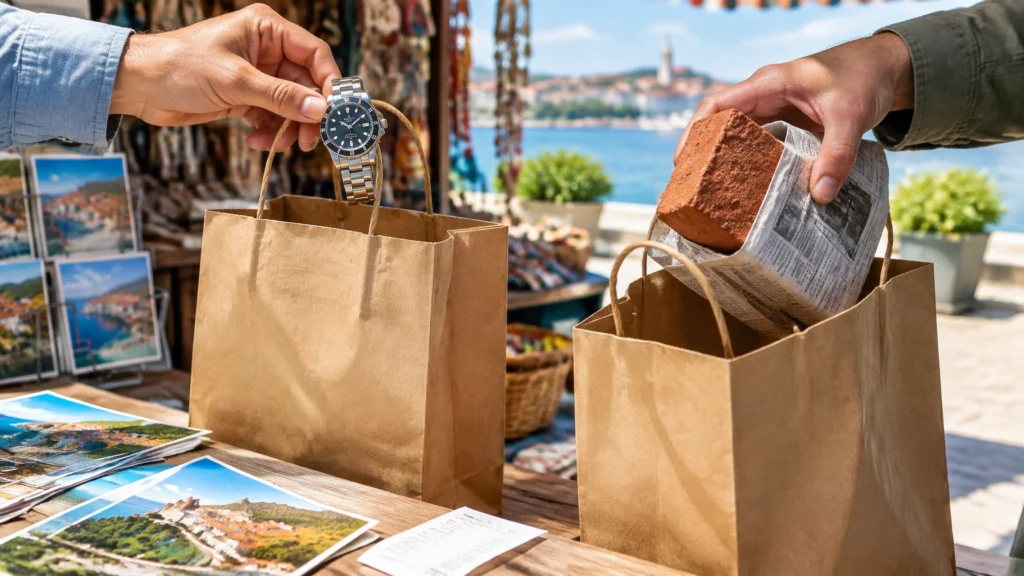
The neighbor looks embarrassed. He paid an outside vendor for an expensive item, watched the seller place it into a bag, and carried the bag home. When he opened it, the expensive item was gone.
In its place were bricks wrapped in newspaper.
Tracer listens carefully. He does not laugh at the neighbor. He laughs at the brick.
The brick is the universal product. It never needs charging, never goes out of style, and has almost no resale value unless you happen to be building a wall. It is also remarkably honest about what it is.
The trick is commonly called the brick scam, brick-in-the-bag scam, or bag-switch scam. The seller shows you one thing, then hands you another. The demonstration is real. The bagging is where the theft happens.
And yes, this can happen to smart, careful people.
The seller creates excitement by showing you a genuine or impressive product. You hold it. You inspect it. Perhaps you test it.
Then the vendor offers to wrap, box, clean, gift-package, or bag the item.
That moment creates the opportunity for a switch.
The seller or an accomplice moves the real item out of sight and replaces it with a brick, stones, weights, sand, newspaper, a counterfeit, or a cheaper product. Sometimes the replacement is placed in a sealed box so you cannot check it.
Most buyers do not open the bag at the stall. They may feel rude doing so. The vendor has been friendly. The buyer is excited. A flight, ferry, tour, or long drive is waiting.
The discovery comes hours later, when returning is difficult or impossible.
This is not a mistake. It is not an innocent mix-up. The bag was packed with intent.
1. The full brick.
The bag contains bricks, stones, sandbags, newspaper, or metal weights. Sometimes a real box sits on top so the package feels correct.
2. The gradedown.
The item shown is genuine and high quality. The bag contains a cheaper lookalike, counterfeit, used product, or damaged version. The packaging may be copied carefully so the weight feels right.
3. The sealed box.
The seller says the box must remain sealed for customs, tax-free treatment, warranty protection, or shipping rules. “Sealed for your protection” may actually protect the seller from inspection.
4. The weight trick.
This version affects produce, coffee, spices, bulk goods, and small traders buying stock. The buyer agrees to a price per unit, then the goods are shorted, swapped, or padded with something else during weighing or bagging. Agree on the price before anything is cut or weighed.
5. The ship-it-home promise.
The vendor accepts payment and promises delivery. Nothing arrives, or the package contains the wrong item. The buyer never gets to inspect the purchase at the point of sale.
6. The customs-and-duty upsell.
After the purchase, the seller or a supposed courier demands another fee for customs, tax, insurance, or delivery. The extra charge is part of the fraud.
7. The accomplice bump.
A second person jostles, distracts, asks a question, or creates an argument while the first person packs the item. These teams may operate at markets, cruise ports, festivals, and roadside stands.
Distance is the scam’s greatest ally.
When you are out of town, you may not be able to return to the stall. You have a plane, ship, train, or long drive to catch. The vendor may have no permanent storefront, local business record, or verifiable address.
A receipt may show no business name, tax number, or phone number. Crossing a border makes enforcement even harder. A police report filed on the last day of a trip may create a record, but it may not lead to money or a replacement.
Language differences can also make confrontation uncomfortable. The seller knows this. The seller counts on your schedule, uncertainty, and desire to remain polite.
The item was real. You held it. That creates confidence.
The vendor was warm and helpful. Refusing to trust the seller feels impolite.
You have limited time. Excitement narrows attention. The switch happens during movement, conversation, payment, or wrapping.
Most importantly, you may never have seen this exact trick before. That is not naïveté. It is a first encounter with a practiced performance.
The same method works on frequent travelers, experienced shoppers, and people who regularly read scam warnings. The pressure is applied live, while the seller controls the pace.

Watch the item go into the bag. Do not turn away, answer a phone call, or step aside. The bagging is part of the transaction.
Keep control of the item. Use one hand for the goods and one hand for money. Never surrender both at the same time.
Buy first, bag second. Better yet, watch the item enter the bag, keep the bag in your hand, and pay only after you have seen the contents.
Open the bag before leaving. Say, “I always check before I go: my wife, husband, or brother makes me.” A prepared excuse removes the social pressure. It takes eight seconds.
Never accept an unopened box you have not inspected. If the seller will not open it, do not buy it.
Weigh bulk goods yourself. Use a portable luggage scale when appropriate, count units yourself, and confirm the total price before cutting, weighing, or bagging.
Do not let the item leave your sight. This includes repairs, engraving, wrapping, gift boxing, cleaning, or “checking something in the back.”
Get a complete receipt. It should include the business name, address, phone number, item description, and price. Photograph the receipt, the stall, the vendor, and the item together. A photo showing the stall front, signage, and street is one of the most useful records you can create.
Use a card when possible. A card creates a payment record and may provide a dispute path. Protection is not guaranteed, especially internationally, but a card is usually safer than cash.
Be cautious with shipping offers. Refuse ship-it-home arrangements unless the seller is a real company with a verifiable address, tracking number, and protected payment method.
Treat an extreme discount as a warning. A genuine luxury item sold far below normal retail price is often not genuine, or the deal is not real.
Walk away from urgency and secrecy. “This price is only for you” and “you are the first customer today” are pressure tactics, not proof of hospitality.
Slow down. The rush is part of the seller’s plan. Choose to miss a bargain rather than miss the switch.
For watches, jewelry, electronics, instruments, artwork, rugs, and vehicles, use a higher standard.
Buy from a licensed dealer with a verifiable address. Ask for the serial number and photograph it. Require a written description of the exact item and price on the receipt. Verify authenticity through an independent source before paying.
Use a card or protected escrow method when available. Arrange an independent inspection for a high-value purchase. Watch the exact item being packed, and photograph it before the box is closed.
The few minutes spent verifying a high-value purchase are worth more than the discount.
Preserve everything. Keep the bag, packaging, receipt, messages, brick, counterfeit, substitute item, and any wrapping. Photograph the contents before moving them around.
Write down the time, location, stall description, seller description, promises made, and payment details. Do not throw the evidence away in frustration.
Report the incident to local police and request a written report number. Contact your card issuer immediately and ask about the dispute deadline. If you paid by card, provide photographs, receipts, and a clear timeline.
Report the seller to the consumer-protection authority in the country where the purchase occurred. You may also contact your own country’s consumer-protection office or embassy for guidance.
Recovery is often unlikely. Reporting may not return your money, but it creates pattern evidence that can help identify repeat operators.
Consumer fraud guidance from the Canadian Anti-Fraud Centre and information about bait-and-switch tactics from Keeper Security provide additional background.
Practice these lines before you need them:
Having the sentence ready makes it easier to protect yourself without arguing.
Tracer walks the neighbor through the eight-second check: hold the exact item, watch it enter the bag, keep the bag, open it, and confirm the contents before leaving.
He admits that the brick deserves a certain respect. It is the only part of the transaction that never gets faked, never gets discounted, and never loses its identity.
The rule is simple:
Watch it go in the bag, or do not buy the bag.
Tracer returns to the supply closet and opens a box marked PAPER TOWELS.
There is a brick inside.
He decides not to ask any more questions about the supply closet.
This week:
Tracer’s Pick: Tracer’s Pick giveaway invitation: you can enter in through the Tracer’s Pick giveaway announced on the Community Finds page at FindASpy Community Finds.
For security and documentation gear that helps a traveler keep records, browse the FindASpy catalog. No device replaces careful habits.
Next edition: Tracer looks at how ordinary travel details (receipts, location photos, serial numbers, and payment records) can become your strongest evidence when a purchase goes wrong.
Community Disclaimer: Please do not post names, addresses, passport details, receipts with card numbers, or identifying information about private individuals. Share only what is safe and appropriate.
Have you ever been sold a bag with the wrong contents? What State are you from? What is your one rule for buying expensive items while traveling?
Tracer reads all posts.
You can upload your own hidden gadget to share with the community by clicking here.
Educational content, not legal or consumer-advice guidance. Consumer protections, dispute windows, reporting channels, and remedies differ by country, state, and payment method, and cross-border purchases frequently have no practical enforcement. Readers should confirm current rules with their card issuer, a consumer protection agency, or a licensed attorney in the relevant jurisdiction. Nothing in this article guarantees recovery of funds, a chargeback, or a successful prosecution. This article describes a scam pattern so readers can recognize it and does not accuse any individual vendor or business.
Morning Coffee with Tracer is written for FindASpy.com by Sterling Reed, known as “Tracer,” with a focus on awareness, knowledge, and practical protection.
Your vote helps determine FindASpy Insider’s Readers’ Top Picks. One rating is allowed per reader for each article.
Today’s Coffee Conversation
Tracer shares cybersecurity stories, scam alerts, privacy tips, and investigative insights. Pull up a chair, share your experience, and help shape tomorrow’s discussion.