

Widget, FindASpy headquarters’ senior beagle, has two talents: sleeping through the loudest equipment test and locating unattended food within three seconds.
On Wednesday morning, he demonstrated both.
Tracer had placed his breakfast sandwich beside a French press while reviewing overnight alerts. He turned toward a monitor, reached for his coffee, and discovered that Widget had already eaten the sandwich, removed the napkin from the desk, and was now staring at him with the calm confidence of a dog who believed the meal was legally his.
Tracer pointed at the empty container.
Widget wagged his tail.
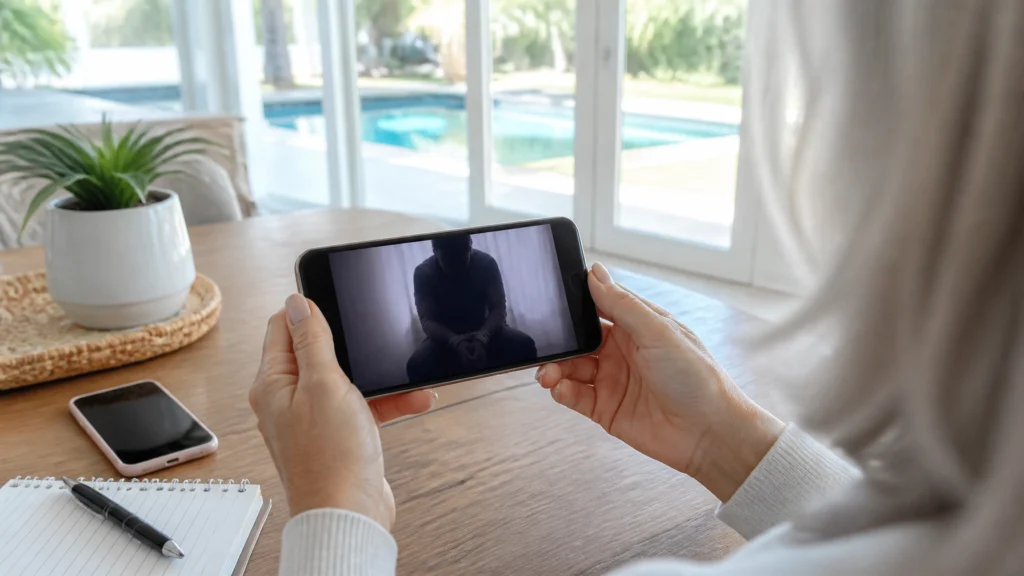
Before Tracer could begin the office’s unofficial lunch investigation, the phone rang. A panicked woman was calling from another state. Her daughter had supposedly been kidnapped. The caller had sent a video.
In the clip, the daughter appeared frightened and restrained. Her voice pleaded for help. A man demanded ransom and ordered the family to send cryptocurrency within thirty minutes.
The video looked real.
The voice sounded real.
The daughter was safe at work, completely unaware that criminals had used her public photos, online videos, and recorded voice to manufacture a kidnapping.
Widget stopped chewing.
Even he understood that this was serious.
Important note: This Coffee Time scenario is a fictionalized account based on FBI and Internet Crime Complaint Center warnings issued in December 2025 and continuing through 2026. The warning pattern is real: criminals use altered or AI-generated media to create fake proof of life and pressure families into sending ransom payments.
A virtual kidnapping is a ransom scam in which no physical kidnapping has occurred. The criminal creates a convincing emergency, then uses fear to make the family pay before anyone verifies the loved one’s safety.
The process is straightforward:
Criminals collect public material.
They scrape photos, videos, social media posts, livestreams, and audio clips. Proud grandparents often post pictures of grandchildren. Families share vacation videos, birthday messages, graduation clips, and voice recordings. Working parents post family updates between busy schedules.
They build false media.
Generative artificial intelligence creates an altered photo or fabricated video showing the loved one appearing bound, injured, or distressed. The criminal pairs the fake video with a cloned voice made from publicly available audio.
They create the emergency.
One caller claims to be a kidnapper. A second voice, using the cloned voice of the loved one, cries or begs for help. The caller demands secrecy and insists that every minute matters.
They demand a difficult-to-recover payment.
The ransom request directs the family toward cryptocurrency, gift cards, wire transfers, payment apps, or another method that moves money quickly and makes recovery difficult.
The FBI’s December 2025 IC3 warning specifically describes criminals using altered photos from social media and public websites as fake proof of life. The warning notes that close inspection often reveals missing tattoos or scars, inaccurate body proportions, and other inconsistencies. Criminals also use timed messages that disappear before the family has time to examine them carefully.
In 2026, the public is also seeing continued warnings about AI-generated video and voice cloning in impersonation schemes. The technology is moving quickly. A familiar face, voice, or video clip is no longer independent proof of identity.
This scam attacks emotion, not intelligence.
Seniors and retirees often maintain large family networks. They receive regular photos from children and grandchildren. A criminal who studies those public posts learns names, relationships, travel plans, schools, workplaces, and favorite expressions.
Working families face a different pressure. Parents are moving between meetings, school pickups, commutes, medical appointments, and household responsibilities. When a familiar voice says, “Please help me,” the natural reaction is immediate action.
The criminal designs the call to block careful thinking:
Fear narrows attention. It makes a family focus on the video instead of the verification process.
That is the trap.

The caller demanded cryptocurrency and refused to let the family speak directly with the daughter. He said the video was the only proof they would receive. He ordered the family to keep the call active and threatened violence if anyone contacted the police.
The family watched the clip again.
The daughter’s face looked unusually smooth. A small scar near her eyebrow was missing. Her voice sounded close to the real voice, but the rhythm was stiff. The lighting did not match the room shown in her recent photos. The video was also sent through a disappearing-message feature.
Those details did not prove the video was fake by themselves. They did prove that the family needed independent confirmation before acting.
The family used another phone to contact the daughter’s workplace. A coworker walked to her desk.
She was safe.
The kidnapping never happened.
Choose a word or short phrase that only close family members know. Do not use a birthday, pet name, street name, or detail displayed publicly online.
Teach everyone how to use it during an emergency. If a caller claims to have a family member, ask the supposed victim for the code word. Do not announce the code word to the caller.
A code word does not replace law enforcement or direct verification. It creates one additional layer of protection when a voice or video appears convincing.
Use a separate phone. Call the loved one’s saved number directly. Contact their workplace, school, travel companion, spouse, or another person who is physically near them.
Do not use a phone number supplied by the caller. Do not rely on a social media account controlled by the scammer. Verify through a channel your family already trusts.
If the loved one does not answer, continue the verification process. An unanswered call is not proof of kidnapping.
Tell another trusted relative what is happening. Ask that person to verify the loved one’s location through an independent route.
The scammer wants to isolate one frightened person. A second family member introduces a calmer decision-maker and creates another path to the truth.
If the caller orders you to keep the situation secret, treat that demand as a major warning sign.
Do not send cryptocurrency, gift cards, wire transfers, or cash because a caller demands immediate action. Payment does not establish that a kidnapping occurred, and it does not guarantee the loved one’s safety.
If you need time, say that you are arranging the funds. Keep the caller talking only if doing so is safe. Use another device to contact law enforcement and family members.
If you believe someone faces immediate danger, call 911 or your local police department. Do not wait for the scammer’s permission.
Screenshot the video, save text messages, preserve caller IDs, record phone numbers, and write down the exact payment instructions. Keep copies of emails, audio messages, cryptocurrency wallet addresses, gift card information, and timestamps.
Do not edit the original files before saving them. Evidence helps investigators identify patterns and connect related incidents.
Report the scam to the FBI’s Internet Crime Complaint Center at IC3.gov. Include the phone numbers, payment details, messages, audio, and proof-of-life media. Report even when no money was sent.
For additional privacy or digital-security concerns, FindASpy’s services include cyber consultation, spyware and breach removal, secure communication support, and professional detection services. Patricia can be reached at 321-342-0040 for guidance about available options. Do not use this number instead of 911 during an active emergency.
FindASpy also provides privacy-focused products through all products. Product use must follow applicable law and the site’s responsible-use policy.
AI-generated media is improving faster than many families realize. A loved one’s face can appear in a fabricated scene. A familiar voice can deliver words that person never spoke. A video can create the emotional impact of evidence without proving anything about the person’s real location.
The safest response is simple:
Stop. Breathe. Do not pay. Verify independently. Contact someone you trust before sending money.
If the situation is genuine, law enforcement and trusted family members need accurate information. If it is a scam, every minute spent verifying protects your money and gives investigators useful evidence.
Read more about the people behind FindASpy and our privacy mission on the About Us page. Our goal is not to increase fear. It is to replace panic with awareness, knowledge, and protection.
Disclaimer: This article is for general educational purposes and is not legal, law-enforcement, emergency, medical, or financial advice. If someone faces immediate danger, call 911 or your local emergency service. Do not confront a suspected criminal. Preserve evidence and contact the appropriate authorities. Product and service decisions should be made after considering your circumstances, applicable laws, and guidance from qualified professionals.
Has anyone in your family created a private emergency code word? If not, what is stopping you from setting one up this week?
Which State are you reading from? Have you received a suspicious family-emergency call, voice message, or video? What detail first made you question it?
Tracer reads all posts, and he wants to hear how families, retirees, investigators, and working professionals are building safer communication habits.
If you discover a suspicious device or hidden gadget, protect your privacy and share the discovery with the community by clicking here. Private information stays protected, and submissions are reviewed before publication.
Tracer is also keeping the Tracer’s Pick giveaway on the radar. If you enjoy these Coffee Time articles, check FindASpy’s current updates for future giveaway details. Participation is optional, and no purchase is required unless the published terms specifically state otherwise.
A face and voice are familiar details, not proof of safety. A private code word, direct contact, second-person verification, and a calm reporting process give your family a stronger defense against AI-enabled virtual kidnapping scams.
Before your next cup of coffee, choose one family code word. Tell the people who need to know how to use it, and agree on which trusted channels you will use to verify an emergency.
Tomorrow, Tracer examines another urgent digital threat and the small verification habit that keeps a trusted space from becoming an attacker’s shortcut. If your family finds a hidden gadget while checking phones, vehicles, or home spaces, upload it for the community at Community Finds.
Your vote helps determine FindASpy Insider’s Readers’ Top Picks. One rating is allowed per reader for each article.
Today’s Coffee Conversation
Tracer shares cybersecurity stories, scam alerts, privacy tips, and investigative insights. Pull up a chair, share your experience, and help shape tomorrow’s discussion.